

The Unwanted Old Normal: The Cost of Adjournments on Justice Delivery
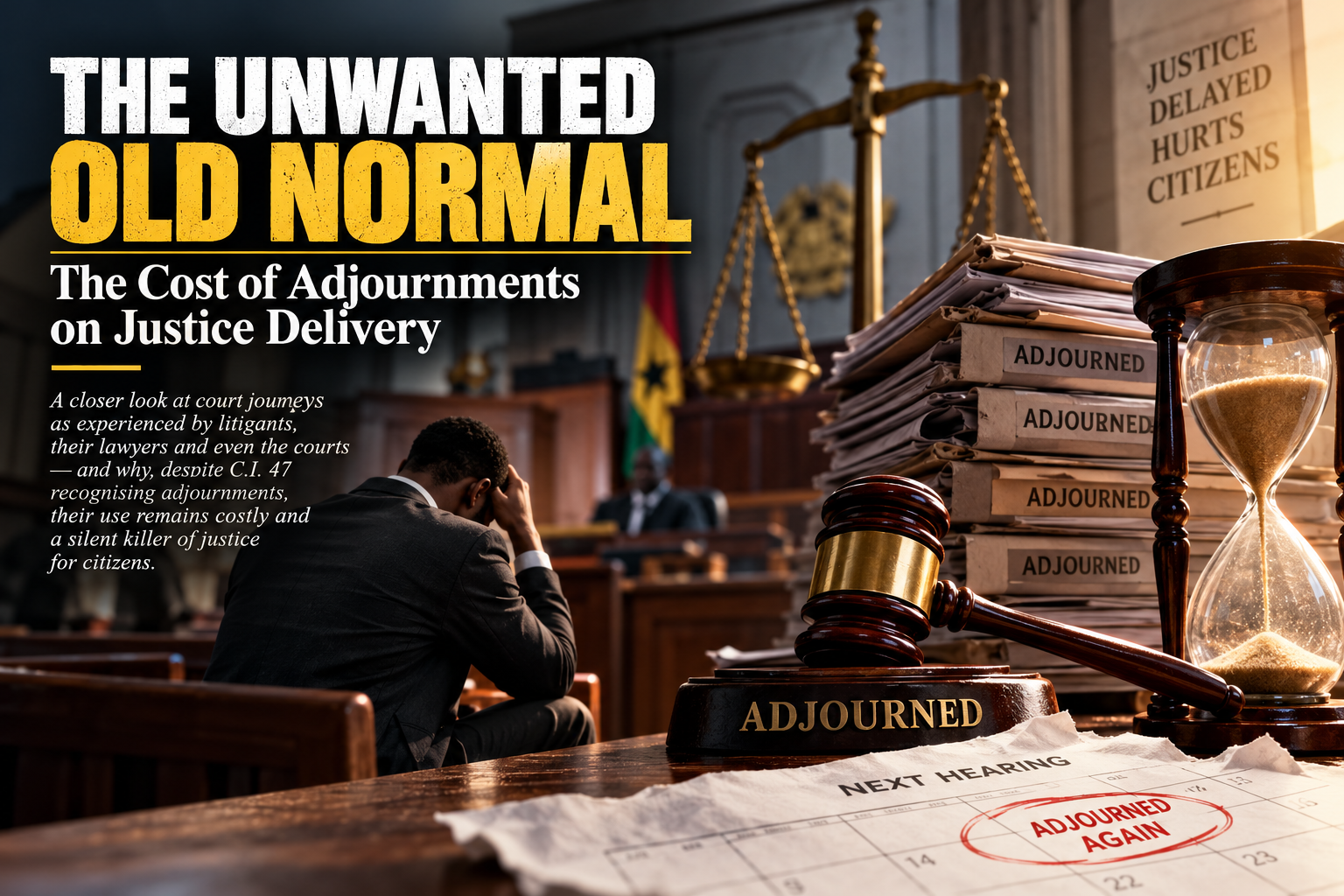 When the journey to justice becomes more punishing than the wrong that brought the citizen to court.
There is a peculiar tragedy in our administration of justice: a citizen may approach the courts seeking relief from an injustice, only to discover that the process of obtaining justice has become another injustice to endure. The litigant arrives in court, hopeful that the machinery of justice will move. Counsel is prepared, documents are assembled, witnesses have abandoned their daily engagements, and considerable expense may have been incurred merely to honour a hearing date. Then comes the familiar announcement: Matter adjourned. Two words, pronounced in a few seconds, yet their consequences may extend into months, years, depleted savings, lost opportunities, fading memories and, occasionally, the death of the very person for whom justice was sought. The court records another date, the lawyers update their diaries, the litigants return to their lives, if indeed they can afford to resume them, and the system moves on as though nothing consequential has happened.
This is the unwanted old normal of our civil justice system: the gradual institutionalisation of delay through a procedural mechanism designed to facilitate justice, not frustrate it. The problem is not that adjournments exist. Every serious justice system must accommodate legitimate interruptions, particularly where fairness, unforeseen circumstances or the proper administration of justice demands them. The difficulty arises when adjournment ceases to be an exception justified by necessity and becomes a predictable feature of litigation, sometimes expected, occasionally exploited and too readily accepted. At that point, what began as a procedural accommodation risks becoming an institutional defect, one whose consequences are borne disproportionately by the citizens the justice system exists to serve.
C.I. 47: A Procedural Permission, Not a Philosophy of Delay
Ghana’s High Court (Civil Procedure) Rules, 2004 (C.I. 47), recognise that civil proceedings may require adjournments. That recognition is neither surprising nor objectionable. Litigation involves human beings, contested facts, procedural safeguards and circumstances that cannot always be anticipated. Nevertheless, the recognition of a procedural power must never be confused with an endorsement of its routine exercise. The governing philosophy of C.I. 47 is expressed in Order 1 rule 1(2), which requires the Rules to be interpreted and applied to achieve speedy and effective justice, avoid delays and unnecessary expense, and ensure, as far as possible, the complete, effective and final determination of matters in dispute. These objectives are not ornamental decorations in a legislative instrument. They are substantive interpretive directions intended to inform the exercise of procedural powers throughout civil proceedings.
The Rules contemplate both fairness and efficiency, neither of which should be sacrificed at the altar of the other. They do not demand speed at the expense of a fair hearing, nor do they permit procedural fairness to become a convenient vocabulary for avoidable delay. An adjournment may be perfectly lawful when considered in isolation and yet contribute to a pattern of case management inconsistent with the broader objectives of the Rules. The legality of an individual adjournment does not necessarily establish the justice of a system characterised by repeated adjournments. A court may possess the discretion to adjourn proceedings, but that discretion is neither an entitlement enjoyed by parties nor an administrative convenience available without consequence. It must be exercised judicially, for proper reasons, and with due regard to the competing interests of those before the court.
Indeed, the more frequently an adjournment is sought, the greater the need to interrogate its necessity, justification and cumulative effect on the proceedings. Otherwise, the exception quietly swallows the rule, and the very procedural mechanism intended to safeguard fairness becomes an obstacle to its realisation. The purpose of civil procedure is not simply to ensure that every procedural step is observed, but to facilitate the just determination of disputes within a reasonable time and at a proportionate cost.
The Hidden Economy of Adjournments
One of the most troubling features of adjournments is that their true cost rarely appears in the judicial record. The record may indicate that counsel requested an adjournment, the opposing party did not object, and the court granted the application. What it will not ordinarily disclose is that a market trader closed her shop to attend court, a commercial driver forfeited a day’s earnings, an employer paid for legal representation without obtaining meaningful progress, or a witness travelled several hours only to be informed that the matter would not proceed. These are not incidental inconveniences. They are real economic losses imposed by the justice process, although they seldom feature in the formal assessment of whether another adjournment should be granted.
The actual cost of an adjournment extends far beyond legal fees. It includes transport and accommodation, lost working hours, witness expenses, additional preparation, the opportunity cost of immobilised assets and the psychological burden of prolonged uncertainty. Consider a relatively modest civil dispute in which a litigant spends GH₵500 on transport, subsistence and lost earnings for each appearance. Ten ineffective appearances would translate into GH₵5,000 in direct and opportunity costs, even before professional fees and other expenses are considered. For a litigant pursuing a claim of GH₵20,000, that illustrative figure represents one-quarter of the amount in dispute. The arithmetic is simple, but its implications are profound. The system may eventually deliver a judgment, yet the cost of reaching that judgment may have consumed a substantial portion of its practical value.
The consequences become even more disturbing in disputes concerning land, inheritance, employment, family property or contractual obligations, where the injury caused by delay cannot always be reduced to an immediate financial calculation. A business may collapse while awaiting resolution, an employee may remain without income, a family may live under uncertainty over ownership of its home, or a witness may become unavailable as evidence deteriorates. Delay does not merely postpone the resolution of a dispute; it can fundamentally alter the circumstances in which the dispute is ultimately determined. A judgment delivered after the commercial, personal or evidential value of the claim has been substantially eroded may constitute a legal victory with little practical justice. The cost of adjournments must therefore be understood not simply as the expense of another court appearance, but as the cumulative cost of unresolved rights.
The Law Has Already Identified Those Responsible
Perhaps one of the most compelling provisions in C.I. 47 on this subject is Order 37 rule 2, which places responsibility for avoiding unnecessary adjournments and delays upon the parties, their lawyers and the court. Its significance lies in the deliberate distribution of responsibility. The obligation is not imposed exclusively upon litigants or their legal representatives, nor is it confined to judicial officers. The Rules recognise that effective justice delivery requires the cooperation and discipline of every participant in the adjudicatory process. The court’s power to grant an adjournment must consequently be understood alongside the shared responsibility to ensure that proceedings are disposed of as speedily as the justice of the case permits.
Yet the practical reality is frequently more complicated. A litigant may seek repeated adjournments to exhaust an opponent financially, counsel may request additional time because of competing engagements, incomplete preparation or tactical considerations, and a court may be unable to proceed because of an overburdened docket, administrative difficulties or circumstances beyond the immediate control of the presiding judge. These situations are neither morally nor legally equivalent. Genuine incapacity should not be equated with calculated obstruction, and institutional resource constraints should not automatically be mistaken for judicial indifference. Nevertheless, their consequences frequently converge upon one unfortunate person: the citizen waiting for justice.
This is why the discussion must move beyond the familiar accusation that lawyers delay cases or judges tolerate adjournments. The problem is more complex and concerns a litigation culture in which procedural time is sometimes treated as though it belongs to the professionals administering the case rather than the citizens whose rights are at stake. Judicial time is a public resource, and court appearances are not costless rituals. Every wasted hearing consumes institutional capacity that could have been deployed to resolve another dispute. An adjournment therefore has consequences beyond the immediate litigants, imposing an opportunity cost upon the administration of justice itself.
When Delay Becomes a Litigation Strategy
There is an uncomfortable truth that the legal profession must confront: in certain disputes, delay can become commercially or strategically advantageous. A defendant who remains in possession of disputed property may benefit from the passage of time, while a party retaining contested funds may have little incentive to accelerate proceedings. An economically stronger litigant may also be better positioned to withstand repeated appearances and escalating legal costs than an opponent of modest means. The danger is not simply that justice is delayed, but that delay can distort the balance of power between litigants and transform procedural endurance into an advantage unrelated to the merits of the dispute.
A claim may be legally strong but economically unsustainable. A party may possess compelling evidence yet lack the resources to continue prosecuting the case. Eventually, that litigant may abandon the action, accept an unfavourable settlement or simply stop attending court. In such circumstances, the dispute has not necessarily been resolved according to its merits; it may have been resolved by exhaustion. The winner is not always the party with the better case. Sometimes, it is the party who can afford to wait longer. That possibility should disturb every institution committed to the rule of law, because a civil justice system cannot be indifferent to the prospect that procedural delay may function as an instrument of economic coercion.
The right to bring an action is of diminished practical value where the cost of sustaining that action becomes prohibitive. A courthouse may remain physically open while access to meaningful justice becomes economically inaccessible. The formal availability of a remedy does not necessarily guarantee its practical accessibility, particularly where the process required to obtain it imposes burdens that are disproportionate to the value of the claim or the resources of the claimant.
The Constitution Does Not Promise an Endless Journey
The concern is not merely procedural; it has constitutional dimensions. Article 19(13) of the 1992 Constitution expressly requires that an adjudicating authority established by law for the determination of the existence or extent of a civil right or obligation be independent and impartial and that proceedings before it be given a fair hearing within a reasonable time. Article 23 separately requires administrative bodies and officials to act fairly and reasonably and comply with requirements imposed upon them by law. Although these provisions differ in their scope and application, they reinforce the broader constitutional expectation that the exercise of public authority must be consistent with fairness, legality and reasonableness.
A fair hearing is not concerned exclusively with the opportunity to speak, tender evidence or challenge an opponent’s case. Its integrity also depends upon proceedings being conducted within a reasonable period. Reasonableness is, of course, contextual. A complex commercial dispute involving multiple parties, expert evidence and difficult legal questions cannot be measured by the same timetable as a straightforward debt recovery action. Complexity, however, must not become an all-purpose explanation for institutional inertia, just as the constitutional requirement of reasonable time must not be reduced to an abstract aspiration incapable of influencing everyday case management.
It is entirely possible to observe every procedural formality and still preside over a process whose cumulative delay undermines effective justice. This is the paradox that deserves attention: a justice system may remain procedurally active while becoming substantively unproductive. Hearings are scheduled, applications are filed, records are updated and dates are assigned, yet the underlying dispute remains unresolved. Activity is mistaken for progress, and the citizen, whose understanding of justice is understandably measured by outcomes rather than procedural events, is expected to maintain confidence in the system.
Justice Delayed Is Not Always Justice Denied; Sometimes It Is Justice Destroyed
The familiar maxim that justice delayed is justice denied has become so frequently repeated that its force is in danger of being lost. There is, however, a more troubling dimension to the problem. Sometimes justice is not merely denied by delay; it is destroyed by it. Evidence deteriorates, memories fade, witnesses relocate or die, businesses become insolvent, disputed property changes character, and family relationships fracture beyond repair. A court may ultimately pronounce a legally impeccable judgment in favour of a litigant whose circumstances have been irreversibly altered by the years spent waiting. What, then, has justice achieved?
This question is not intended to diminish the importance of legal correctness. A speedy but erroneous judgment is no triumph of justice. Rather, it recognises that legal correctness and reasonable expedition are complementary obligations. The object must be neither hurried justice nor leisurely perfection, but timely, fair and effective adjudication. The true measure of a justice system should therefore extend beyond the number of cases filed, hearings conducted or judgments delivered. It should include the practical value of the remedies ultimately obtained and the burdens imposed upon citizens in securing them.
The Adjournment Nobody Pays For
Another dimension of the problem is accountability. When an adjournment is granted, who bears its cost? Frequently, the answer is the litigant, irrespective of who occasioned the delay. C.I. 47 recognises the court’s authority to impose appropriate terms in connection with adjournments, while the broader procedural framework provides mechanisms for dealing with costs. These powers offer a means of addressing avoidable interruptions where the circumstances justify their exercise. Nevertheless, costs must not be confused with punishment, nor can they always restore the actual losses suffered by an innocent party.
A costs order may compensate for some unnecessary expenditure, but it cannot necessarily restore a lost business opportunity, reverse psychological distress or recover years of uncertainty. Equally, the prospect of adverse costs should not be deployed mechanically against genuinely deserving applications, particularly where fairness requires additional time. The more fundamental question is whether the system sufficiently recognises the economic consequences of wasted hearings when exercising its discretion. An adjournment should not be assessed solely by asking whether the requesting party has offered a plausible explanation. It should also be assessed by considering the prejudice likely to result, whether that prejudice can be mitigated, whether a less disruptive alternative exists and whether the application forms part of a recurring pattern. Judicial discretion becomes more meaningful when exercised with a clear appreciation of cumulative consequences.
From a Culture of Adjournments to a Culture of Case Progression
Reform does not necessarily require another elaborate legislative instrument. The law already supplies important principles, and the challenge is to translate them into consistent procedural practice. A credible reform agenda should begin by ensuring that adjournments are reasoned, purposeful and connected to identifiable procedural objectives. Every material adjournment ought to have a justification, and wherever practicable, the court should be satisfied that the intervening period will be used to advance the proceedings rather than merely postpone them. Genuine necessity must be distinguished from avoidable unpreparedness, with illness, unforeseen emergencies, legitimate evidential difficulties and circumstances affecting fair hearing rights receiving proper consideration without extending the same indulgence automatically to routine failures of preparation.
Active case management must also become the prevailing culture. Matters capable of being resolved through directions, agreed timetables, electronic processes or other lawful procedural mechanisms should not invariably require parties to undertake costly physical appearances. Courts should consider costs more deliberately where adjournments are unnecessarily occasioned by a party’s conduct, subject always to judicial discretion, proportionality and fairness. Equally important is the need to measure ineffective hearings rather than relying exclusively upon case disposal figures as indicators of judicial performance. The number of adjournments, their causes, intervals between hearings and the age of pending cases are useful management indicators which, when properly collected and interpreted, can reveal structural inefficiencies without reducing judicial independence to numerical targets.
The legal profession must also exercise greater responsibility. Counsel owe duties not only to their clients but also to the administration of justice, and legitimate advocacy does not require the unnecessary prolongation of proceedings. None of these measures implies that every adjournment is improper or that judicial officers should be pressured into refusing necessary applications merely to satisfy performance expectations. A court that sacrifices fair hearing rights in pursuit of speed commits an injustice of its own. The objective is disciplined discretion, not mechanical rigidity, and a system in which procedural flexibility remains available without becoming an excuse for institutional complacency.
We Must Stop Celebrating the Movement of Files as the Movement of Justice
Perhaps the most important reform is cultural. We must reconsider what constitutes progress in litigation. A case that has appeared before a court fifteen times without meaningful advancement has not necessarily received fifteen opportunities for justice; it may have experienced fifteen episodes of institutional inefficiency. A hearing date is not itself an achievement, an adjournment is not a neutral administrative event, and the movement of a case file from one date to another must never be mistaken for the movement of justice.
There is a fundamental difference between a justice system that accommodates necessary delays and one that has become accustomed to them. The former respects the complexity of adjudication, while the latter risks normalising inefficiency. The distinction may be subtle within the courtroom, where procedural events are recorded in familiar language and repeated as part of ordinary judicial business, but it is painfully obvious to the citizen financing the journey. For that citizen, every ineffective appearance represents another expenditure of money, time, patience and confidence in the institutions entrusted with the protection of rights.
The Citizen Must Remain at the Centre of Justice Delivery
At the heart of this discussion is a simple proposition: the civil justice system exists for the resolution of disputes, not for the perpetuation of proceedings. Its procedures are instruments of justice, not ends in themselves. Lawyers must remember that their professional calendars are not more valuable than the time of their clients. Litigants must recognise that procedural rights should not be converted into weapons of deliberate obstruction. Courts must remain conscious that every adjournment, however justified, has consequences extending beyond the record of proceedings. Policymakers, for their part, must appreciate that access to justice is not exhausted by the availability of court buildings, filing procedures and judicial personnel.
Access to justice must also be measured by the affordability, timeliness and effectiveness of the remedies that the system makes available. A person who cannot afford to remain in litigation may be practically excluded from justice even where the doors of the courthouse remain open. This is not merely a problem of procedural efficiency. It is a question of public confidence, institutional legitimacy and ultimately the rule of law. When citizens begin to perceive litigation as a financially exhausting undertaking with no reasonably predictable conclusion, the danger extends beyond individual disputes. It threatens confidence in the capacity of the legal system to resolve grievances through lawful and peaceful means.
Conclusion: The Date Is Not the Justice
There is something deeply unsettling about a legal system in which a citizen can faithfully attend court for years and still struggle to identify any meaningful progress towards the determination of a dispute. The tragedy is compounded when each adjournment appears reasonable in isolation, while their collective effect becomes manifestly unreasonable. C.I. 47 did not envisage a system in which the objectives of speedy and effective justice would be recited as admirable principles while unnecessary adjournments were accommodated as ordinary business. Order 1 rule 1(2) establishes the destination, while Order 37 rule 2 places responsibility for reaching it upon the parties, their lawyers and the court. The two provisions must be read together, not treated as unrelated procedural statements.
The question, therefore, is not whether courts possess the power to adjourn proceedings. They plainly do. The more important question is whether we have become sufficiently comfortable with the exercise of that power to overlook its cumulative consequences. An adjournment may be lawful, and it may even be necessary, but its frequency should never make us indifferent to its cost. The citizen who approaches the court is not purchasing hearing dates. That citizen seeks the vindication of a right, the resolution of a dispute or a remedy for a wrong. We owe that citizen more than an endless succession of appearances. We owe that citizen a justice system in which time is respected, procedural discretion is responsibly exercised and delay is treated as a problem to be justified rather than a tradition to be preserved.
For when justice becomes a journey without a reasonably foreseeable destination, the courthouse may remain open, but the promise of justice begins to close. The date is not the justice. The adjournment is not the achievement. And a system that repeatedly postpones the vindication of rights must eventually confront the possibility that it is postponing justice itself.
Author:
Desmond Israel, Esq. is a Lecturer and Head of Department of Public Law And Governance at the GIMPA Law School, He is also a Partner in charge of Cyberlaw & Technology Practice at AGNOS Legal Company, a Lead Consultant at Information Security Architects Ltd and a Senior Policy Analyst with Institute for Liberty and Policy Innovation (ILAPI)
Principal legal references: Constitution of the Republic of Ghana, 1992, Articles 19(13) and 23; High Court (Civil Procedure) Rules, 2004 (C.I. 47), Orders 1, 36 and 37.
Editorial note: The financial example is illustrative rather than an empirical estimate.